Because Counting Our Blessings Just Isn't Enough

This post was collaboratively written with Jessica Johnson (@principalj) and William King (@wkingbg)

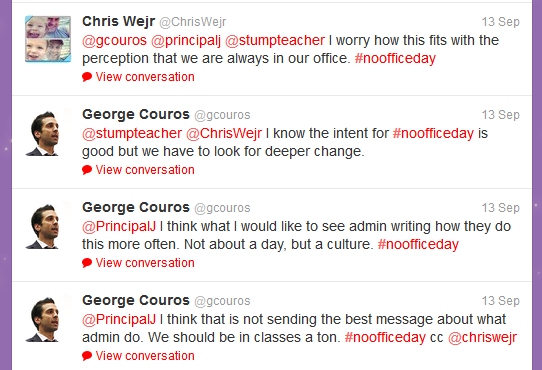
Serious critique deserves serious response. When several educators we respect wondered aloud on twitter about whether No Office Day sends a poor message about administrators, we took their reservations seriously.

Upon further reflection, we still love #NoOfficeDay.

For those not yet familiar with No Office Day, it is a day (or numerous days) on which principals and other school leaders shut our offices down and spend the entire day where learning happens – among our teachers and our students. Here are some of the original #NoOfficeDay principal posts that inspired the rest of us: No Office Day by David Truss, Be There by Lyn Hilt and International No Office Day by David Truss.

Does No Office Day mean we never spend other time out of our office?  Of course not!  Effective principals are typically hard to find in their offices, because they are the “lead learners” of their building and are usually already in classrooms to observe learning.  #NoOfficeDay days are part of more comprehensive approaches by principals to transform our roles from “experts” directing teachers and managing to full participants in learning, focusing the school on a culture of collaboration to support student learning.  It is a day or several days in which principals immerse themselves into teaching in specific grade levels, certain subjects or throughout the building. It is time for principals to keep “in touch” with teaching and learning.

No Office Day is merely one component of a more nuanced tapestry of the role of the principal and the way in which principals and other school leaders engage in learning. We each spend significant time daily in classrooms, not merely “driving by” as walkthroughs have been appropriately critiqued, but reshaping our roles to be more like coaches than evaluators.

It is important to note that while we are out and about all the time many principals still end up spending large amounts of time in the office.  Discipline referrals, parent meetings, scheduling, community partnerships, paperwork,etc.  Some of these efforts are not “busywork” such as meeting with teachers on their professional learning goals and partnering with parents to support their children. Still, we’d be lying if we said we never got caught up in “busywork”.  In some districts, it is more the norm for seasoned administrators to stay in their office and fill the role of manager as compared to instructional leader.  No Office Day allows  the opportunity to light a fire under some of these principals (and central office staff) who haven’t taught a day since leaving the classroom for administration.

We can find No Office Day as more of a celebration of the great things we are doing (coaching, teaching, leading).  Celebrating these things motivates those around us who may be set in their ways and have forgotten what it’s like to be in the trenches.  It’s sad that that’s the case but its true.  Last year many principals and central office staff (including superintendents) got involved and they had a blast.  It really changed some of the mindset of administrators, resulting in regular No Office Days the rest of the year.

While educators that are not principals  may be critical of #NoOfficeDay, we realize that it is sometimes difficult for teachers to understand all the responsibilities that principals take on day to day.  None of us realized how tough administrators have it…until we became one!

Want to read more from other principals on #NoOfficeDay?  You can find their posts here.

Cross Posted on http://www.connectedprincipals.com and principal.blogspot.com

CC licensed image shared by flikr user HikingArtist.com

Last week, our educoach chat (a twitter chat dedicated to instructional coaching and professional learning) focused on the topic of giving feedback. We shared our own experiences giving and receiving feedback and reacted to articles from the most recent issue of Educational Leadership Feedback for Learning (September, 2012, Vol. 70, No.1). Feedback is a topic we delved into in depth this summer as part of our book discussion chat on John Hattie’s Visible Learning For Teachers. Synthesizing more than 900 educational meta-analyses, researcher John Hattie has found that effective feedback is among the most powerful influences on how people learn. (John Hattie, Know They Impact, Educational Leadership Feedback for Learning September 2012, Vol. 70, No. 1)

Feedback matters.

I’ve recently come to embrace the idea that great principals and great teachers have at least three important habits in common.

  • They offer feedback effectively.
  • They have strong feedback loops for themselves, learning and growing professionally by incorporating feedback they receive.
  • They show appreciation.

In 7 keys to effective feedback, an article in the most recent issue of Educational Leadership (Feedback for Learning: September, 2012; Vol. 70, No.1), Grant Wiggins writes: “the term feedback is often used to describe all kinds of comments made after the fact, including advice, praise, and evaluation. But none of these are feedback, strictly speaking. Basically, feedback is information about how we are doing in our efforts to reach a goal.” Wiggins then shares that helpful feedback is goal-referenced; tangible and transparent; actionable; user-friendly (specific and personalized); timely; ongoing; and consistent.

Giving feedback is not easy for principals for a variety of reasons. There is the challenge of time. With 56 teachers in my school, and only one of me, offering feedback that is timely, ongoing, and consistent has been difficult. There is the challenge of experience. Most of us have given and been given advice, praise, or evaluative critique rather than  feedback. And, perhaps most significantly, there is the challenge of role expectation. Principals, at least as I was trained years ago, have been viewed primarily as evaluators, giving “expert” advice and assessment, rather than sharing nonjudgmental observations with teachers for the purpose of professional learning and growth.

Despite the inherent challenges, I have come to recognize that giving feedback effectively to teachers can be among the most significant contributions a principal can make to improving the quality of learning in our schools. So, how can principals overcome the challenges and offer effective feedback? For your feedback, I share the seven steps to effective feedback I am using.

Step One: Schedule significant time be in classrooms.

What is in our calendar gets done. It is difficult to offer effective feedback without having experience of learning and teaching, day in and day out, in our own schools. My own practice is to schedule two hours daily to be present in classrooms for learning and teaching; either observing or preferably engaging with learning in whatever ways teachers request.

In addition to daily time in classrooms, I schedule six No Office days during the year, one with each grade K-5, on which I spend the entire day, from arrival to dismissal, with a grade. Teachers can assign me to do whatever they would like on these No Office Days. These days are valuable to me in assisting me to get a feel for the rhythm of the day in each grade.

This year, as a birthday gift to each of our teachers, I will be teaching one period of their class on their birthdays. I also hope to cover for an hour on the birthdays of our other building administrators, office staff, and perhaps even our maintenance crew. Teachers and staff members can schedule the birthday class so that they can come late, leave early, extend lunch, or remain and watch me. (There is already a line of teachers hoping to observe me teach physical education, which should be a class filled with good spirit, humility, and laughter.) Teachers and staff members can also take a rain-check for another day at their convenience if their birthday is not on a school day or even if another day will simply work better for them. In addition to offering teachers and staff members the gift of time, which I wish I could do even more often, teaching each class will offer me perspective on the joys and challenges of learning and teaching in our school.

Step Two: Schedule time for formal conversations with teachers to discuss professional learning goals, supports to reach goals, and to assess progress being made.

This year I will be scheduling three formal meetings during the year with each of our faculty members. At the first meeting, taking place between September and November, we will set together a professional goal, an action plan to meet the goal, supports to reach the goal, and criteria for measuring progress and success.  At the second meeting, scheduled between December and February, we will discuss progress toward the goal, confer on how supports are working, speak about whether feedback offered has been helpful, and make modifications as necessary. At the third meeting, taking place between March and the end of the academic year, we will reflect on professional growth during the year.

Success will not be determined based on whether teachers meet their goal. There could be a goal easily met without much growth or a stretch goal, not met yet with enormous professional growth. Each teacher will fill out rubrics we created together as a faculty for our school’s Standards for Professional Practice. I will fill out the rubrics for each teacher to the best of my ability based on observations and conversations we have throughout the year. These rubrics are not only an assessment for teachers, but are also an assessment for me and my knowledge of learning and teaching in each classroom. I will leave blank what I cannot complete based on direct knowledge of learning and teaching in each class, thereby recognizing those areas about which I need to learn more. Each teacher and I will compare the rubrics and discuss.

Step Three: Make feedback nonjudgmental and goal-focused

My notes on classroom visits will offer nonjudgmental feedback; phrased with the prompts we as a faculty have learned to use together on our learning walks in each other’s classrooms: I notice. I wonder. What if? How might? I will strive to connect feedback to each teacher’s professional learning goal. And, I will seek teachers’ input on what type of feedback and information will be most valuable to them as well as on whether the feedback I am offering is helpful.

Step Four Make use of technology as a support, but focus on the relationships and face to face interactions

I have created a notebook in my very favorite app, Evernote, titled “teachers” and I have created a note for each of our teachers. I will add to the note after each of our formal meetings and after each classroom visit. Each time I add to a teacher’s note, I will send the the teacher a copy with the most recent additions at the top of the note. These notes will become a record of our ongoing reflective conversation and will take the place of a formal evaluative end of year write-up.

Although utilizing Evernote to organize myself, I will focus on face to face interactions. I won’t bring my computer or Ipad into classrooms as teachers rightfully complained last year that I wrote on my Ipad in class rather than engaging in learning. I will carry my cell phone, primarily for emergencies during which my administrative assistant texts me. Having the phone with me does enable me to jot down a note if really worried I will forget. Generally, however, I remember what I want to write and record notes after students have left for the day. Some teachers write back to me, reflecting on feedback. Just as I have had meaningful conversations with colleagues in my professional learning network utilizing social media, I have had meaningful conversations with teachers in my school using e-mail. Other times teachers stop me in the halls or request time to speak to follow up on feedback offered and I love those ongoing face to face interactions. All teachers will have a minimum of three face to face conversations in which I focus my attention exclusively on their professional learning.

Step Five: Compliment

While in classrooms, if I am not interrupting, I will share  a compliment with each teacher on the spot. I recognize having a visitor in one’s class and hearing nothing can be disconcerting. Regardless of whether I can speak directly without interrupting, either in class or face to face afterward, I will share a compliment on something wonderful happening in the classroom along with the  brief, written feedback I send. While I accept Grant Wiggins’ explanation that feedback and compliments are not the same thing, and I do strive to make a clear distinction, it is important to me to ensure that I compliment and show appreciation for our teachers regularly.

Step Six: Be transparent about evaluation

I plan to function far more with a “coach’s hat” than an “evaluator’s hat”; yet if at any time I need to relay a concern as an evaluator, I will be direct in letting teachers know I have on my evaluator’s hat and am giving advice or clarifying expectations rather than sharing nonjudgemental feedback.

Step Seven: Seek feedback

It is vital for me not only to offer feedback, but also to receive feedback, opening myself to perspectives of teachers, staff members, parents, and students. I have thus sought to create a multitude of venues in which I request and strive to embrace feedback. As I share feedback with teachers, I simultaneously ask teachers for feedback. I was gratified when one of our new teachers shared that the two phrases she hears over and over are: How can we help you? And, give us feedback so we can do better. Our PTO provides valuable feedback from parents and I schedule parent-principal conferences on parent-teacher conference days and throughout the year, encouraging parents to speak with me directly. I continue to consider ways in which to receive feedback from teachers, other administrators, staff members, parents, and students. And, I will openly acknowledge, I appreciate the compliments I sometimes receive as well.

In line with seeking feedback, I ask for your thoughts. What do you notice and wonder about these seven steps and about effective feedback more generally? What other considerations might be helpful? How might you adapt or improve upon these steps?

I look forward to your feedback!
Our Countdown


Our countdown to the first day of school is here, at least for those of us in districts and regions that have not already started the 2012-2013 school year.

 For many of us, our countdown includes additional counting. We count with numbered lists: “to do”, ideas, activities, lessons, tools, tips, and general wisdom lists.

Some of my favorite bloggers have chosen to share their lists. With gratitude to them, I’ve collated a new countdown; not a countdown to the first day of school, but a countdown for the first days of school and for the upcoming year.

10 Ideas For Transforming Your Teaching This School Year By Shelly Terrell

9 Tips For Collaboration Starting The School Year From Edutopia

8 First Day Of School Activities From Powerful Learning Practice

7Mobile Apps Students Can Use To Never Loose Handwritten Notes Again From Free Tech For Teachers

6 Ways Principals Can Connect With Students By George Couros

5 Edmodo Activities For The First Day Of School From The Edmodo Blog

4 Favorite Edtech Tools To Inspire Your Lessons From Educatorstudio

3 Tools Every Virtual Learning Environment Needs From Focus On Edtech K-12

2 Things Everyone Wants From Brett Clark

1 Most Important Thing I Learned In School From Educational Leadership

Please don’t hesitate to share some of your favorite lists for the upcoming year. Our countdown is on!

cc licensed image shared by flikr user kjarrett

“What would school look like if we could really do what we are being asked?” teacher leader Mike Ritzius (@mritzius) passionately inquired at Edcamp Leadership during a session he titled, organizing for organic leadership. Mike’s answer for the public vocational tech high school in New Jersey where he teaches involved a radical rethinking of the use of time and space in school, along with a dramatic redesign of curriculum and student support. While the scope and specifics of Mike Ritzius’ innovation address vastly different concerns than those we face at my school, his emphasis on the importance of empowering teachers with the authority to make decisions based on student need prompted me to wonder. What would school look like if we could really do what we are being asked? What would school look like if teachers were really empowered to make decisions, even bold decisions requiring rethinking and redesign, based on student need?

Edcamp Leadership, which took place this past July in New Jersey, was my very first edcamp experience. For those who have not yet attended an edcamp, they are “unconferences”; free participant driven professional learning experiences. At Edcamp Leadership, a poster board listing times and room numbers, but no session names, was propped up on a window sill. Volunteers passed out brightly colored post-it notes, encouraging participants to sign up to facilitate a session. While many of us tentatively stood by, wondering whether we should facilitate a session or not, other brave learners stepped forward and stuck a post-it note up with their session topic, their name and their twitter handle onto the board. The day’s schedule was born! The schedule was immediately posted on Edcamp Leadership’s web page for all to access and off we all went for a day of engaging conversation and learning.

In addition to Mike Ritzius’ session, I attended Evernote for Teams, Professional Learning Communities and students with Sharon McCarthy @ienvision; He, She, They, We: Tools for Faculty Evaluation and Development with Dr. David Timony @DrTimony; and Managing Change with @DLE59 (who I still know only by twitter handle). The “what would school look like if” theme permeated all of the sessions I attended. What would school look like if we used web 2.0 tools such as Evernote more effectively to promote true collaboration within schools? What would school look like if faculty evaluation and development was truly designed around the needs of teachers as professional learners? What would school look like if we provided effective supports as we manage change?

Throughout Edcamp Leadership, I learned with some of the smartest educators I have ever met. Principals and school administrators struggled openly, sensitively and wisely concerning the challenges we face. Yet even more compelling to me were the voices of the teachers present. Dr. Timony’s session was particularly relevant to me. As dedicated, knowledgable administrators talked passionately about the time we spend in classrooms, equally dedicated, knowledgable teachers shared their frustrations with administrators’ visits, explaining that students don’t act as they naturally would during administrators’ walkthroughs and observations, teachers feel as though they are “on stage”, and most significantly, administrators do not offer the feedback teachers‘ crave to improve practice. The teachers’ words resonated with me. I wondered and I probed, seeking to learn what might make principals’ engagement in learning and teaching more valuable to teachers. It is a conversation I am pursuing, both with teachers in my professional learning network and even more poignantly, with teachers in my own school.

At the sessions on Evernote and managing change, teachers and principals had more similar perspectives to one another. We shared ways of using Evernote, an app for note-taking and archiving, to collaborate more effectively. We reflected on the difficulties of change: insufficient time, insufficient support, negativity about new directions, a sense of entitlement among individuals who feel they do not need to change, and finally, the threat of extinction if we do not change. While we spent most of the session sharing insights into ways of patiently addressing difficulties with change, we ended with a potent conversation about how schools’ declines are generally gradual. A participant shared the often used anecdote of a frog in cold water that is slowly heated, with the frog not realizing the danger until it is too late. I left wondering how we can we balance patience with the urgency of our students’ needs; how we can be mindful of recognizing when the water is boiling and help each other to jump out, or rather jump into more effective ways of supporting student learning, no matter how difficult or uncomfortable that jump may appear.

I left Edcamp Leadership wondering; wondering about using Evernote more effectively, wondering about supervision, evaluation, collaboration, and coaching to meet teachers’ professional learning needs, and wondering about managing change. Most of all I wondered about Mike Ritzius’ essential questions. What would school look like if we could really do what we are being asked? What would school look like if teachers were really empowered to make decisions, even bold decisions requiring rethinking and redesign, based on student need?

What do you think?

cc licensed image shared by flikr user pulihora

Forty two million new web pages were created last year and educational technology expert Adam Bellow recommended in a session at ISTE (Interational Symposium on Tech Education) trying just one. Perhaps small is the new huge.

Thinking small, or rather thinking focused, is an initially counterintuitive insight to have taken from a conference of the massive scope of ISTE. I went to San Diego, guided by numerous blog posts on how to avoid being overwhelmed by the immensity of the event: plan “must dos” in advance, leave time for serendipitous conversations, and wear comfortable shoes so as to be able to cover as much ground as possible at least literally if not figuratively.

Taking the advice seriously, I planned my ISTE strategy, making the deliberate decision to  veer away from the “big names” of ed tech (although I couldn’t resist learning at sessions with several ed tech leaders whose writings have guided me). Instead, I sought to connect mostly with by no means “small names” but with important voices not necessarily acclaimed; in the trenches teachers striving to make a positive difference in their schools by integrating technology to improve the quality of learning for their students. I was profoundly inspired by the array of talent among presenting teachers who are engaging students in blogging, electronic portfolios, collaborative writing, multimedia presentations, and global collaborations. I was similarly impressed by the tremendous ability and accomplishment of participants at the conference learning together.  I  found guidance and wisdom in areas of great interest to me.

I returned home and reflected, intending to make some initial decisions on how I might bring my learning at ISTE back to my school, wondering whether I as a principal might potentially teach courses in which students create and collaborate through blogging and electronic portfolios.  Instead of rushing forward with plans, I gave myself permission to slow down and with the more relaxed pace of summer, allow learnings at ISTE to unfold and take shape in my mind without deadline. As the days and weeks passed, and the blog posts I intended to write about my experiences at ISTE swam in my head without making their way quickly into writing, I kept hearing the conversation beneath the conversation at ISTE – the passion of teachers, the gratitude toward principals who nurture and support teachers’ passions, and the frustration with principals who do not nurture and support teachers’ passions as effectively as they might.

I had come to ISTE with the essential question “how can I as a principal more effectively support teachers in my school to improve learning?” I wondered whether in answer to that essential question, the greatest insights might come not from the content of sessions, but rather from the emotions and longings teachers expressed quietly between the lines and beneath the content of sessions. I imagined what teachers at my school might present at a conference like ISTE and recognized a plethora of possibilities: using interactive white boards interactively in kindergarten and first grade, ipads as assistive technology for special education students, social media with training wheels: edmodo as a tool to introduce elementary school students to on-line creative collaboration,  engaging families and students in learning through engaging teacher web pages, from voice threads to voki: giving voice to student voice, and flipping the classroom for the tech tentative teacher. The potential for creating a platform for teachers to share and to shine was sounding more and more  compelling.

Paradoxically, perhaps the greatest gift I received at the ISTE mega conference was a new set of lenses through which to look at professional learning; focusing on small as the new huge. Forty two million new web pages were created last year. Even the most tech tentative among us can try just one.  Perhaps that humble beginning will make a potent difference. Perhaps, just perhaps, small is the new huge.


cc licensed image shared by flickr user The Darling Librarian

The definition of a motion leader is one who motivates the unmotivated in a way that the unmotivated then thank them for, Michael Fullan, ISTE Conference, 2012, Session Title: Stratosphere: Integrating Technology, Pedagogy and Change Knowledge

I came to ISTE (International Symposium on Tech Education) with one essential question: how can I, as a principal, support teachers in my school to improve learning? Perhaps attending an educational technology conference I should have shown more interest in the technology. And, I’ll admit, I was wowed by much of the technology. More significantly, I was moved by the focus on learning.

I gained more than I ever expected, experiencing a shift in a paradigm I had embraced and that has shaped my leadership in recent years. In the very first session I attended Monday morning, Michael Fullan, in true motion leader style, motivated me (ok I was already motivated, but supported me) to shift my perspectives on the role of teacher and by extension the role of principal from facilitator of learning to activator of learning.

Quoting John Hattie, Michael Fullan relayed that there is a .17 effect size on student learning when teachers act as facilitators of learning through problem based learning, simulations and gaming, and individualized instruction. Alternatively, there is a .84 effect size on student learning when teachers serve as activators of learning through offering feedback, accessing thinking, supporting challenging goals, and monitoring learning. It does not take extensive training in statistical analysis to find this research compelling.

I know, we love problem based learning, simulations and gaming, and individualized instruction. And, Michael Fullan did offer appropriate caution in our interpretation of Hattie’s findings, positing that gaming, for example, as currently utilized may not yet be effective but that skilled teachers may develop high quality use. Still, without dogmatic either/or – facilitator or activator – lines in the sand, I accept and appreciate Michael Fullan’s redirection.

Michael Fullan activated my learning even further, leaving me not only with a direction, but also with some concrete steps as to how to move forward. And, again, it’s not about the technology. Wisdom I gleaned included:

  • Offer respect to others before it is earned
  • Engage in impressive empathy, meaning empathy even for those who stand in your way
  • Invest in capacity building – human capital and social capital
  • Build social contagion
  • Eliminate non-essentials
  • Focus on a small number of ambitious goals.

Perhaps it is paradoxical that at a technology conference I walked away with the message that what matters is not new, but eternal. What matters is what has mattered for millennia: the quality of our relationships, our respect for one another, and the supportive environments we create. I spent the rest of the conference attending some fantastic sessions, learning some impressive technology tools, but most essentially, connecting and engaging with others who care deeply about learning. At a conference about what is current, I focused on what is enduring.

To Michael Fullan, the ISTE organizers, the AVICHAI Foundation who sponsored my participation, and the engaging educators with whom I learned, from one of the motivated, thank you!


edJEWcon-hashtagSocial fluency, not technological fluency is the essence of learning in an age of social media. Or, in Angela Maiers’ poetic language, “twitter is not a tool; it is a community.” Privileged to participate in not one, but three learning sessions with Angela Maiers (@angelamaiers) at the EdJEWcon conference, my own learning journey of the past several years gained context, nuance, and meaning.  

I acknowledge; I was star struck. Yet, Angela quickly put me, and I sensed all of us, at ease. She did not seek to present the wisdom of one who has expertise, although she possesses incredible expertise. Instead, she crafted a collaborative learning environment in which we together explored topics that matter, not technology, but rather relationship and community.

Changing the Conversation: Using Technology R.I.G.H.T (in ways that are real, impactful, global, honoring passion, and talent amplifying), the title of Angela’s key note address, framed much of my essential learning not only for the day, but for the entire conference. I began the conference, as shared in my blog post, The Purpose of Ed Tech, acknowledging that we would not be learning about educational technology, as I had anticipated, but rather about creating communities of learning and character in a rapidly changing world. I continued the conference, as shared in my blog post, Comfort with Discomfort, respecting the challenges we face when we are changing communities; honoring our ability to address difficult realities not with stress and discomfort, but with a spirit of possibility, energy and fun. I ended the conference with Angela Maiers’ inspiration to enter learning with the mindset of an invitation to experiment, giving ourselves permission to play and to take play seriously.

Mike Fisher (@fisher1000) co-facilitated Angela Maiers’ first session on social media and personal branding for teachers and schools, and Andrea Hernandez (@edtechworkshop) co-facilitated Angela Maiers’ last session on creating a collaborative, reflective professional learning community with your faculty. Mike helped us recognize that there is no longer a clear division of personal and professional; we instead create, in Mike’s marvelous language, profersional identities. Andrea shared with us ways that social media can strengthen a school community by deepening relationships among those who work together in the same building, yet may not have sufficient time during the work day to connect, reflect and collaborate.

I came to EdJEWcon thinking about educational technology. I left thinking about ways of collaborating as profersionals, with playful energy, to support our students to develop the mindset and skills to enter, sustain, and contribute to their own communities of meaning. In the process, I gained perspective on my own learning journey of the past several years, recognizing that it has been a process of developing ever greater social fluency. There remains a long road to travel; yet a magnificent road, with some stress and challenge, but with much more playful experimentation and creative collaboration.

“How many of you are feeling uncomfortable right now?” Heidi Hayes Jacobs asked at her EdJEWcon conference keynote yesterday. I confess. I didn’t raise my hand. When Heidi Hayes Jacobs emphatically shared that we should feel uncomfortable, I wondered, feeling a bit like the child in class who has just gotten the “wrong” answer. Now please don’t misunderstand, I was riveted by Heidi Hayes Jacobs’ presentation. My mind raced with her notion of “strategic upgrade”; not adding to our already overfull plates but shifting learning experiences strategically to more effectively meet the needs of our students today who are processing information differently, in more social, non-linear ways. I was feeling engaged, open, reflective, and interested. I was considering possibilities , reflecting on how better we might serve our students. I was learning and I was loving the opportunity.

And, yet, suddenly, with Heidi Haye’s Jacobs’ challenge to embrace discomfort, I became uncomfortable. I know, the demands are great. I know, our schools are not yet where we want them to be. I know, with all we have accomplished in our schools, it isn’t yet enough. I know, we have tremendous challenges ahead.

For a moment, I felt a heaviness, allowing the grip of fear of failure when the stakes are our children’s futures to overtake me. Yet, only for a moment. For me, embracing discomfort means becoming comfortable with discomfort. When we strive together to address difficult realities the engagement need not be stressful. We are allowed to have fun.

With tremendous respect for Heidi Hayes Jacob, I permitted myself again to relish in her words, to imagine the possibilities they hold for our school, and to find energy, rather than discomfort, in the challenges she poses. I formulated my own essential question, which stood in the background of my learning for the rest of the day: How can we become comfortable with discomfort through the experience of rapid change in our schools?

The two following sessions offered me context – Leading In a culture of Change with Valeri Mitrani, Julie Lambert and Jon Mitzmacher and Upgrade Curriculum and Assessment with Student Blogfolios with Andrea Hernandez. Each of these extraordinary educators supported me to reflect on my essential question.

Valeri Mitrani and Julie Lambert focused on the factors necessary in managing complex change in a system.
No shared vision leads to confusion.
Missing skills leads to anxiety.
Missing incentives leads to resistance.
Missing resources leads to frustration
Missing an action plan leads to a treadmill (working hard with no results).
Missing results leads to inertia.
Confusion, anxiety, resistance, frustration, hard work with no results, and inertia. Now, there is a recipe for discomfort. And, it’s real. We’ve experienced such discomfort. We know it, relate to it, recognize it, and fear it.

It is also a recipe for possibility. Share a vision. Build capacity and skills. Find incentives in focusing on the values based mission of providing together for our learners. Creatively assess and develop resources even in financially trying times. Plan and develop an action plan collaboratively. Celebrate even the small successes.

Jon Mitzmacher then authentically shared in concrete terms ways he is managing complex change at the Martin J. Gottlieb Jewish Day School, speaking of structural choices his school has made.
They got rid of the computer lab and instead pushed technology instruction into the classroom.
They created a school ning as a virtual space for faculty members to collaborate.
They redefined a number of existing positions with a 21st century and instructional coaching thrust.
They transformed faculty meetings with a focus on professional learning.
Jon Mitzmacher, as Head of School, set clear expectations, defining minimum requirements and raising the bar every year.

As Jon spoke, I connected. We as a school are in the process of making similar choices. I felt energized because I recognized the shared vision, skills, incentives, resources, action plan, and celebrations of successes along the way. And, I appreciate Jon’s open acknowledgement of the discomfort that occurred in the process. He recognizes the discomfort without wallowing in it, astutely open for course corrections in an ongoing process of learning.

Andrea Hernandez spoke in the following session with contagious energy about one strategic upgrade at the Martin J Gottleib Jewish Day School: student blogfolios. A term Andrea has created, a blogfolio is a blog + a portfolio. Beginning last year in kindergarten, third and fifth grade; and this year extending to the entire school third through eighth grade, blogfoloios are offering students at the Martin J Gottlieb Jewish Day School a voice with an authentic audience. Started as digital portfolios on a wordpress blog to use primarily for assessment of learning, students were so excited to receive their own blog that they wanted to write. The magic began! Students became bloggers, in Andrea’s words, “learning to create and creating to learn.”

Andrea was honest, open and reflective about the challenges and discomfort; parent concern about safety and privacy, student interest and engagement growing and waning, and skill building with teachers. She was also clear, blogfolios are a tremendous amount of work. And, yet, Andrea did not seem uncomfortable. The reverse, her energy, excitement and passion were palpable as she shared one example of a strategic upgrade – replacing assessment and writing projects previously on paper and handed in to a teacher with blogfolios that can be shared with an authentic audience. Imagine the possibility!

“It’s not an ed tech conference, it’s a conference on learning and teaching,” Silvia Tolisano (@langwitches) astutely pointed out in the opening keynote of EdJEWcon. In that moment, as in so many magical learning moments in groups, I felt as though Silvia was speaking not merely to the group, but directly to me; gently, caringly, correcting me in order to support my own learning and growth. I had called EdJEWcon an ed tech conference not only once, but just about every time I shared with others where I would be April 29th-May 1st. In that moment, as Silvia defined the purpose of edJEWcon, I understood; I learned; I grew. I was in the presence of teachers skilled in educational technology; but far more significantly, I was in the presence of learners wanting, as Andrea Hernandez (@edtechworkshop) shared in her introduction to the conference, to engage in collaborative co-created learning. With Silvia’s and Andreas’s words, a tone was set for our group of twenty plus individual school teams to become a learning community.   
 
Our responsibilities are significant. The world of education, reflecting the world in which our students are growing up, is changing rapidly. Silvia Tolisano shared that Generation Alpha, those born around 2010, will arrive at school already having a digital footprint. It will be our responsibility as educators to help them make that digital footprint a positive one. I reflected on what a daunting task we share; focused for me not primarily on technology, although the technology matters, but on character. How can we help our students define their own identities in positive, meaningful ways in a world in which so much that was once private is now transparent, shared, and open? How can we support our students to contribute to community in a world in which the very definition of community is in constant flux? 
 
In the past several years, I have grown more comfortable with questions that have no immediate answer; relishing in the creative chaos of finding our way together. I also appreciate the calming voices among us who remind us of the substantial gifts we have to guide us. Jon Mitzmacher (@jon_mitzmacher) did not disappoint, joining his voice to the keynote, pointing to the necessary contemporary skills that have ancient grounding and have always  been part of the fabric of Jewish schools: critical thinking, global connection, second language acquisition, and social learning.  The tension in my body eased a bit and I recognized that  while expectations are high,  we share many supports to reach those expectations.  As much as our world is changing, much remains the same: the importance of character, compassion,  and care. Ultimately, our world remains dependent upon the strength of communities of value.  
 
And so, I add to Silvia Tolisano’s message. EdJEWcon is not an ed tech conference and not even a conference on learning and teaching. EdJEWcon, at least for me, is a conference on creating communities of learning and character in a rapidly changing world.  


“What are all these teachers doing here?” more than one child asked as a group of nine adults filed into the classroom. “Just learning about the great learning you do,” we answered with a smile.  “Shuffling up our professional learning,” I happily thought.

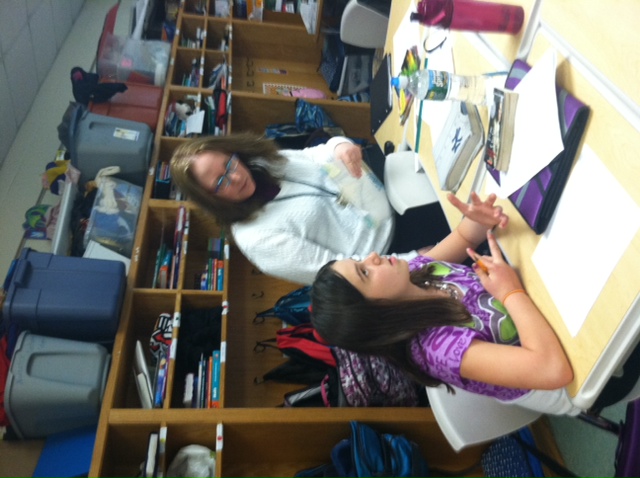
Learning walks have shuffled our professional learning, moving us from our expected “spaces”, or rather classrooms, into our colleagues’ classrooms. This year to date our faculty has celebrated five learning walks (with more to come); in which a group of teachers visit classrooms in each of our grades K-5 along with one specialty class. Our purpose – to break down the isolation of educators, moving us into each other’s classrooms to notice and wonder about learning in our school as it is and as it might someday become.  We plan to make it possible for every teacher in our school to participate in at least one learning walk per year.

What on our learning walk looks different than it would have looked five years ago?  What might look different on our learning walks two years from now?

I posed these two questions during our learning walk debrief. It was the first time I had asked in quite that direct manner. The answers were insightful.

What on our learning walk looks different than it would have looked five years ago?

Whether in kindergarten or fifth grade, and indeed any grade in between, regardless of subject, we saw a similar sight – students spread throughout the classroom working in combinations of small groups, partners, and independently. Teachers were either guiding a group or conferencing with individual students. In only one class, other  than in physical education, were students participating in a full class experience and in that case it was a debrief on work they had  been engaged in independently prior to our visit.  Classroom furniture was arranged to promote collaborative learning and there were comfortable corners for students to read independently or with a partner. There was a relatively noisy buzz of students speaking with one another. There was a mix of required learning activities and opportunity for student choice among various options. There was ample evidence of differentiation and student engagement, the two foci of our learning walks to date this year.

Five years ago, had we participated in learning walks, we would have observed far  more full class experiences led by the teacher and far fewer opportunities for students to choose from among different learning experiences.

What is the same?

While interactive white boards are in each class in the school, in many classrooms we visited they were not being used. Students did not have technology, whatever the specific device, flexibly available for their use. Bulletin boards, for the most part, displayed class expectations and learning resources important all year, as well as substantive, completed student projects which might or might not be connected to current learning experiences. Bulletin boards did not, for the most part, display the most recent student work along with rubrics explaining specific learning goals, with expectations and resources that change as student progress unfolds.

Two years from now we anticipate seeing on our learning walks many more technology tools (whether iPads, laptops, or other devices) available to students in our classrooms, not merely in our computer labs and media center, actively utilized in fluid, flexible organic ways to support student learning. We anticipate seeing evidence of student work in progress, along with rubrics and shifting resources based on student progress prominently displayed and recognizable as the basis for instructional choices, with the spot light visibly on student work to drive instruction. We anticipate even more differentiation and opportunities for choice in learning experiences.

While learning walks are non-judgmental, human emotion and our passion for our craft are not ignored. We huddle in the hall after each classroom visit and reflect using the prompts, “I noticed”, “I wonder”, “What if” and “How might”. The reflections create an opportunity for celebration – joy in our progress along with excitement about possibilities for continued growth.

We notice what we value.  Our recognition of evidence of differentiation and student engagement, the two foci for our learning walks to date is potent. Similarly, our ability to imagine a not so distant future with greater educational technology integration and more substantial focus on student work in progress to drive instruction speaks to our self-awareness as professional learners and reflective educators able to envision learning goals not yet accomplished.

Just as a strategy of good readers is to visualize what they read, a strategy of good educators committed to growth is to visualize school as it might become. By filling in the prompts “I notice”, “I wonder”, “what if?” and “how might?”, our learning walk shuffle not only brought us into “spaces” in our present reality, classrooms of our colleagues, but also shuffled us through the boundaries of time, bringing us to “spaces” of our future, enabling us to envision what we anticipate we will notice on learning walks of our future.  Those images fill us with excitement and energy.