Because Counting Our Blessings Just Isn't Enough

I’m learning and loving it!

Take a look at my first assignment for #Etmooc,  an online learning experience, part course, part community.

The task was: “Create an introductory post, video, podcast, slideshow, etc., of yourself.  Tell us a little bit about yourself – perhaps, where you’re from, what you do, or what you want to be when you grow up – and let us know what you’d like to gain from #etmooc? A few paragraphs of text, or preferably, a form of visual or auditory media lasting between 30 seconds and 2 minutes is ideal. These are very rough guidelines – feel free to break every one of them if you wish.”

I took the challenge and decided to try to have some fun in the process; creating a voki and finding a way to present an introduction in 60 seconds. It took some thinking and tinkering, but I am proud of what I accomplished.

And, I’m enjoying the learning. For the first time since I finished my doctorate almost 15 years ago, I’m back in class as a learner. Only this time, it’s not a brick and mortar classroom; it’s on-line courses I can engage with on my own time, in my own space, and at my own pace. I’m participating in: Charting a New Direction for Online Learning with Online School for Girls#Etmooc, coming soon Fundamentals of Online Education: Planning and Application and recently completed #Leadership20Series.

I’m also learning regularly with two very special on-line communities of practice with which I am involved: #educoach and YU2.0.

In our #educoach chat on January 9th, 2013, we discussed: Moving From Knowing To Doing, inspiring me to move from “knowing” that one can easily podcast or vodcast without great levels of technical expertise, to actually “doing” and creating my first voki.

I have similarly been motivated to learn and expand my skills by some recent robust conversation on YU2.o on podcasting and vodcasting including: Why Not Use Avatars to Create Vodcasts by Cindy Zemel, Podcast in the Classroom by Amy Bond, Changing My Ideas About Podcasts and Vodcasts by Elyse Haber, Podcasting in Education: @TeacherCast – A Great Resource by Rebecca Penina Simon, Uses for Podcasts and Vodcasts by Elana Schwarzberg, and Advantages of Podcasts/Vodcasts by Chagit Alpert. All of these conversations on YU2.0 stem from the Yeshiva University Institute for University School Partnership Educational Technology Certification program taught by Rabbi Meir Wexler.

So, in celebration of my steps forward into a new world learning, I want to thank all who are part of my learning journey!

Today is the first anniversary of Sharing Our Blessings.

I celebrated, in the past several days, in a way I could not have imagined possible when I wrote my first post: Introduction of a Reluctant Blogger. I celebrated new educational bloggers. I remember my own excitement and gratitude when Edna Sackson (whatedsaid.wordpress.com, @whatedsaid) and Cristina Milos(ateacherswonderings.posterous.com, @surreallyno) commented on my first post. I didn’t imagine that the just one year in the future I would be welcoming new bloggers, not as an “expert” but rather as an accessible role model and guide, providing encouragement, support, and gratitude for the learning and insights these educators are sharing.

Screen Shot 2013-01-09 at 5.03.17 AM

Sunday I commented on new blogs by  Joey Sagel(principaljoey.wordpress.com – What Keeps Your Engine Running,  @principaljoey)  and Rabbi Michael Bitton – Rabbi Mike’s Edtech Blog – How To Blog (rabbimichaelbitton.blogspot.com,  @RabbiMBitton).

In addition, I’ve had the great pleasure of seeing a good number of educators, many of whom at least do not yet blog, reflect recently on blogging on a Community of Practice I am privileged to facilitate YU2.0 (yu20.org). These include: Welcome To Blogging by Chagit AlpertResearch Projects And Blogging by Molly HazanBlogging Concerns by Miriam StrulowiczThe Power Of Blogging – It’s Much More Than The New Persuasive Essay by Rebbeca Penina Simon, and Not All Who Could Should Blog by Rabbi Pollock. I love engaging and learning with the skeptics as well as the committed bloggers.

Why do I blog? I blog because I long to learn with others, contributing what I can, reflecting in order to stretch my thinking.

Happy Birthday Sharing Our Blessings! Looking forward to the learning the coming year can bring!

There was a time, before Columbine, when school shootings were unimaginable; the very definition of an evil so unspeakable as to be in our minds essentially impossible.

I have never forgotten the seriousness with which my  fourth grade teacher, Mrs. Jackson, defined “evil”. An educator nearing the end of her career, Mrs. Jackson captivated my imagination with the detail, nuance, and emotion with which she conveyed tales of how her family survived the Great Depression. She often had substantive conversations with us about topics connected to character and values. With all she shared, it was her definition of “evil” that most shaped my world views. In response to our class’ use of the term “evil” as slang, dramatizing minor, annoying behaviors, Mrs. Jackson sat us down for one of her serious chats. “Evil,” she said, “would be a terrorist entering a school and shooting children.” The image horrified; representing what we could not imagine as even conceivable. I never again used the word “evil” for anything short of the mass murder of defenseless people.

Then came Columbine. The inconceivable occurred; only at the hands of troubled youth, not terrorists. And this Friday, the massacre at Sandy Hook Elementary School in Newtown, Connecticut.

After Columbine, as a relatively new educator and new mother, I was painfully unprepared for the fear of my students and their parents. Hearing students speak about where they would hide if armed attackers entered our school, I recognized the need for reassuring conversation, yet I had no idea what to say. I hastily directed teachers, similarly unprepared, to speak to their students about the tragic event. Sending teachers into a panic and understandably angering our school’s guidance counselor, who recognized how ill-equipped we all were, I was swayed to reverse my directive. We would say nothing. It was the best we had at the time. It wasn’t enough.

This monday will be different. Never prepared to speak of the unspeakable, sadly, we have more experience. Since the days and weeks after September 11, 2001 school psychologists have rallied with a plethora of resources to help. Compilations of resources guiding parents and educators include: Resources for Talking To Children About Traumatic Compiled by Michael Fisher of Digigogy and Resources for Talking to Children About Traumatic Events Compiled by Edutopia.

Our school’s educational leadership will spend much time this weekend planning ways of supporting our children physically and emotionally. In preparation for our children’s return to school, our faculty will meet at 7:30 AM monday morning. We will support one another in finding ways of shepherding our children through the difficult emotions we anticipate. We will be in close communication with our on-site security and our security consultants, who quickly on Friday patrolled the perimeter of our campus and stood in close supervision of teachers and students playing outside during recess. We will be in contact with our local police department; who rushed to our school on Friday after news of the shooting to patrol, on high alert. The officer who arrived, visibly emotional, shared that it was his privilege to be able to be present with us and his hope that there was also police presence at his own children’s school.We will  be guided by the wisdom of our school psychologist concerning age-appropriate conversations. We will be supported by our school rabbi who will listen to our pain and provide us with prayers to express the deep emotion we experience. We will grieve. We will express gratitude for the privilege of being alive. We will do our best to strengthen one another so that we may be fully present for our students.

As quickly as we can, we will return our students to comforting routines. Soon, on the surface, school will look as it always has. Students, parents, and teachers will again be concerned about academic challenge, social difficulty, and the range of normal upsets and tribulations that are part and parcel of growing up and of life in schools. And yet; the unimaginable has occurred and the scars will remain. We’ll study our emergency plans more carefully; consider more thoughtfully how to explain lock down drills to our students; and deliberate on what we as schools and as society can do to keep our children safe. I can’t anticipate what our conversations as a school and as a nation will bring. We will do what we can to bring comfort, knowing that we live in a world in which the unimaginable has occurred. We’ll do what we can to find the words to speak about the unspeakable.

Dreams from the Dojang:
On Less Teaching, More Feedback, and Goals of Consequence

First published in Mr Brett’ Clark’s Education Dreamer: 12 Days of Dreaming Series

I am in training to become a martial artist.
In this goal I will face many challenges.
I dedicate myself to face them with honor, respect, and modesty.
I pledge that on this journey not only will I train my body to be strong, agile and flexible but
I will focus on being a Taekwondo practitioner with self-control desire and discipline.
These ideals and all aspects of my training are my responsibility to learn.
Student Oath, Master P.L. Edwards, Exceptional Taekwondo Center, White Plains, N.Y

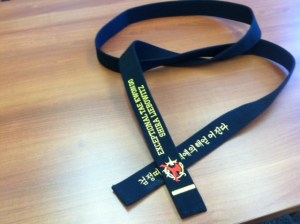
Black Belt photo

Some of my best professional learning happens at the Taekwondo Dojang. As I train, I learn – not only about martial arts, but also about education, or more accurately, about learning. I’m not the strongest, the most agile or the most flexible – not by a long shot. Most of the other students are younger and more physically fit than I. Yet, with perseverance and good humor, I have earned my black belt. I have learned.

My successes are a direct result of a learning environment with less teaching, more feedback, a focus on core values, and a plethora of meaningful learning activities, serving both as practice and then as formative assessments that demonstrate to me progress toward my own goals. Some of my goals are significant (to become a martial artist); others are of ultimate consequence (to strive for excellence in all areas of my life), while many are small and specific (i.e. to turn my hip more to extend my reach in a kick.) Achieving my goals involves much more feedback than teaching and the responsibility for learning is entirely my own, although I benefit both from the skilled coaching of the master instructors and from the collegial support of the other students. It’s a learning environment I dream about for our K-12 schools.

Less teaching; more feedback, recommendations offered by Grant Wiggins in Seven Keys to Effective Feedback sounds simple on the surface, yet I believe represents an educational paradigm shift of potentially seismic proportions. Indeed, Everything you know about curriculum may be wrong. Really., Wiggins declares in his blog. He advocates a focus, not only on content knowledge, but rather on learning to perform in the world and even more, on learning “not just to know things – but to be a different person – more mature, more wise, more self-disciplined, more effective, and more productive in the broadest sense.” Performing well trumps content knowledge and striving to fulfill core values and make a positive impact is ultimately what performing well entails.

The shift to a focus on less teaching and more feedback grounded in core values will require thoughtful reflection. Synthesizing more than 900 educational meta-analyses, researcher John Hattie has found the average effect size of feedback to be a remarkable 0.79, which is twice the average effect of all other schooling effects. Indeed, Hattie found feedback to be among the top ten influences on achievement. But there is a caveat. While feedback is among the most powerful influences on how people learn, its effects vary considerably. (Hattie, John. Visible Learning for Teachers: Maximizing Impact on Learning. Taylor & Francis. Kindle Edition)

To give effective feedback, we’ll need to understand what effective feedback is and what effective feedback is not. The insight may surprise. Feedback, according to Grant Wiggins in Seven Keys to Effective Feedback, isn’t grades for students. It isn’t evaluations for professionals. It isn’t praise. It isn’t constructive critique. It isn’t advice. Rather, “feedback is information about how we are doing in our efforts to reach a goal.”

I am dreaming of a K-12 educational system that functions more like the Dojang with less teaching, more feedback, and goals of consequence. The journey toward fulfilling that dream will not be easy. Much will shift and change. Yet, at the same time much will remain the same.

We’ll need to envision education anew – shifting our focus from teaching to learning; from curriculum to feedback on practice; from standards to core values. These shifts will require us to think differently about potential ways of utilizing learning spaces, schedules, personnel, student groupings, and technology in order to improve the quality of learning. The possibilities are limited only by our imaginations and will require collaborative, creative exploration and dreaming.

We’ll need at the same time to consider what must not change, but instead remain grounded in enduring core values. It will be vital to set goals of ultimate consequence connected to our core values and to identify clearly many specific benchmarks along the way to these aspirational goals. The journey will stretch us beyond standards and move us from a primary focus on what students need to know, or even on what students need to be able to do, to an emphasis on who students are becoming – individuals of character and moral grounding prepared to strive to make a positive impact in their communities and in the broader society.

I am dreaming of less teaching, more feedback, goals of consequence, and the society children who emerge from such an educational system will together be able to create. I invite you to dream with me and share your perspectives on ways of moving forward.

CC licensed image shared by flickr user Svadilfari

CC licensed image shared by flickr user Svadilfari

A curious thing appears to have happened at my school. Over the course of the past two years, it seems we’ve decreased the amount of homework we give. At least, I think we have. We haven’t had an official policy change, or even any recent formal discussions as a faculty about homework. But there’s been informal collegial reflection.

My information to date is only anecdotal. Yet, it appears potentially significant. A growing number of teachers have reported parental gratitude for reduced homework loads. I’ve received far fewer calls from parents complaining about too much homework; indeed only one or two in the past year and a half. And, very recently I’ve heard from several parents wondering why there isn’t more homework, concerned that perhaps the lack of work assigned at home reflects a lack of rigor in our school. After conversation, the few parents who have expressed to me their concern about what they perceive as too little homework have come to understand and respect the increasing quality of learning experience and achievement at our school resulting from intensive recent attention given to revisions in curriculum and assessment. Homework, I’ve explained, is not the way to evaluate what is occurring in school, but rather educational quality must be judged based on evidence of student learning. Quite, fairly, some thoughtful parents have recommended that we clearly articulate our school’s approach to homework. What we have written in our parent handbook, crafted with the active collaboration of our entire faculty, has not been revised recently and is a remnant of practices of years past, no longer accurate or reflective of our approach.

I have indirectly addressed homework in posts on our school blog in the past; The Homework Parents Give Me: A Deepening Dialogue Between Home and School; May 13, 2011 and Making Homework Meaningful and Manageable; September 8, 2011. Although those posts hint at conversations that were occurring among teachers and parents about homework, they are neither sufficiently recent nor sufficiently clear and direct. They are merely glimpses into a more quiet, yet potent, shift. Parents, or at least some of our parents, long for and deserve more. So do many of our teachers, having a strong sense of what their colleagues believe, but not a comprehensive understanding. Providing parents and teachers with the clarity they appropriately seek cannot be my task as principal alone; but must represent a shared faculty understanding and vision.

I wonder whether my perception that there is less homework assigned in my school than in past years is accurate. And, if there is less homework, I wonder how this reduction has come to be. I wonder how homework is integrated with school learning and how we can evaluate the impact of homework on quality of student learning. I imagine that serious dialogue and reflection among teachers during the last few years about what does and what does not positively impact student learning has led to shifts in practice in many areas, including homework.

But, how can I know? Well, certainly I can ask.

We will be conducting a survey of our teachers on what and how much homework they assign. We’ll share survey results with the entire faculty at a morning “breakfast and brainstorming” (our version of faculty meetings, focused not on administration or even on professional learning traditionally defined, but rather on dialogue as a faculty on topics that impact student learning). We’ll consider our own perspectives and reflect on some of the available research. Homework: What The Research Says Brief, National Council of Teachers of Mathematics is a concise, balanced brief quoting respected studies. Worth reading, the brief concludes that there is experimental evidence that homework for young children can improve scores on unit tests involving simple mathematics skills such as learning place value, but that homework does not appear to have much impact on broader measures of achievement for young children. John Hattie’s research is also of note. Synthesizing more than 900 educational meta-analyses, Hattie has found that the effects of homework are small, and close to zero in elementary school. Of 138 influences on learning included in Hattie’s expansive study, homework scored 88th. [Hattie, John (2012-03-15). Visible Learning for Teachers: Maximizing Impact on Learning (Kindle Location 408). Taylor & Francis. Kindle Edition.]

Hattie urges teachers to utilize the finding on the minimal impact of homework as an invitation to try something new.  He shares that many schools in New Zealand did not abandon homework because too many parents judge the quality of a school by the mere presence of homework and get upset if there is none, but instead tried different approaches. One school worked with students and parents to create a website of various ‘home challenges’ and evaluated the effects of this new policy on student motivation, achievement, and parent involvement with their children’s learning. [Hattie, John (2012-03-15). Visible Learning for Teachers: Maximizing Impact on Learning (Kindle Locations 382-393). Taylor & Francis. Kindle Edition.] 

So, what’s the point of homework? What learning makes sense to extend from school to home or alternatively from home to school? And, what processes might you suggest for a faculty to come together and determine collaboratively the role of homework, or perhaps more poignantly the role of home learning connected to school learning? What processes might you suggest for including parents, and even elementary school students, in that conversation? I welcome your input.

I don’t often have favorites. At times I wish I did: a favorite color, a favorite season, a favorite holiday, a favorite movie, a favorite book, or a favorite food. I imagine there is a comfort in favorites, something to turn to that is familiar and beloved. Yet, I relish in variety, option, and possibility, finding it virtually impossible to choose a favorite of anything. And so, true to form, I struggle with the edublog awards. Should I sit it out; not nominate and not vote as there are so many who are worthy? Or might there be value in participation, however imperfect?

Two years ago, new to the world of connected learning, the lists of nominations for the edublog awards directed me to the very first blogs I followed regularly. Last year although I didn’t nominate, I voted. Sad that I couldn’t vote for more educators making a positive impact on my own learning, I was nonetheless grateful to be introduced to bloggers new to me with whom I continue to learn. This year, I’ve decided to nominate a few educators important in my own journey as a learner. While they are by no means the only educators from whom I learn, they are individuals who regularly offer me valuable insight, perspective, and wisdom.

On October 17th, 2012,  Radical Learners returned after a long hiatus during which Jim Knight was writing his new book  High-Impact Instruction, which I look forward to reading.  Two of his prior books: Instructional Coaching and Unmistakable Impact have made an “unmistakable impact” on my practice as an educational leader, assisting me to incorporate coaching mindsets and skills into my work as a principal. I’m grateful to now be able to learn not only from his valuable books, but also from weekly reflections on his blog, published every Wednesday.

TeacherCast, a place for teachers to help other teachers, takes four of my nominations: best group blog, best educational use of audio/video/visual/podcast, best mobile app, and best educational use of a social network. Just a year and a half old, TeacherCast continues to expand its offerings as a community of practice dedicated to bringing teachers together to learn, share, and dream about what is possible in education.

Described as a blog on globally connected learning, and not educational technology per se, Silvia Tolisano is wise in her use of implementing educational technology, thoughtful in the global connections she facilitates, but even wiser and more thoughtful in her reflections on ways of improving the quality of student learning, often with the creative use of technology.

Inquisitive, creative, humble, energetic, and passionate, Maureen Devlin provides insight into the journey of a master teacher, focused on her own students’ learning while connecting her experiences as a teacher to essential questions facing the field of education more broadly.

“Remember everything. Capture anything. Access anywhere. Find things fast.” The promise of Evernote is fast becoming a reality for me and while it is the app I use most often, replacing any other place for creating or storing information, I feel I have only scratched the surface of this remarkable resource.

Edcamp Leadership, which took place this past July in New Jersey, was an extraordinary learning experience for me, which I wrote about here. Highlights for me included learning with Dr. David Timony and Mike Ritzius, two educational thinkers who have since become important members of my professional learning network.

For a truly generous spirit, I nominate best individual tweeter and lifetime achievement award to Jerry Blumengarten, otherwise known as cybraryman. Jerry Blumengarten has personally selected more than 20,000 relevant educational links from the internet for students, teachers, administrators and parents. On those rare occasions that cybraryman does not have a page on his web site on a topic of educational interest, he is tremendously skilled at connecting educators within his vast network with one another in order to learn and to share.

There are so many more worthy of award from whom I learn frequently. To all, a huge thanks!

Learning On-Line


Move fast – don’t be afraid of failure

Empower your dreamers – say “yes”

Develop a vision and tie it to your mission

Focus on areas of most importance

Think about connecting with others

Brad Rathberger

Director, Online School for Girls

cc licensed image shared by flickr user Derek Purdy

As happens time and time again, at a professional learning experience related to technology, I learned not as much about technology as about learning.

I’ve enrolled in Charting a Direction for Online Learning, a year long course designed for educators at independent  schools. The course is sponsored by Online School for Girls, a learning organization serving a consortium of independent girls schools by assisting member schools to collaboratively develop blended learning experiences for their students. Most of the learning in this professional course occurs on-line, yet this past week I attended the first of two face to face sessions.

“Blended and online learning is as evolving of a field is there is in education. It is flipped on its head every six months or so,” shared Brad Rathberger, Director of Online School for Girls. We are beginning to recognize the potential to dramatically shift control of learning from teachers to students not as much through the technology as through the previously unimaginable potential for flexibility in the use of space and time made possible with technology.

Among the greatest moments of learning was the opportunity to hear from a number of students at School of the Holy Child. “We learn a lot about responsibility, academic integrity, learning to work with other people, and flexibility,” shared one of these very impressive high school seniors, reflecting on a course she was taking in multi-variable calculus. Participating in a college level math course, and interacting with some of the top female high school math students in the country, she interestingly didn’t reflect as much on math or technology, as on learning and growth, noting with maturity how she is less shy and more able to manage her time than she had been prior to her online learning experience.

While one cannot make generalizations about online and blended learning as there are so many approaches, evolving so rapidly, there are a number of broad models currently in use:

  • Rotation Model
  • Flex Model
  • Self-Blend Model
  • Enriched-Virtual Model

Rotation Model

Station Rotation Model

  • Students rotate through three broad types of activities in a continuous loop: individualized online instruction, teacher-led instruction, and collaborative activities and stations. This is the simplest blended learning model.
  • Alternatively, instead of one component of online learning there are two components, the individualized on-line instruction and the on-line assessments. Students rotate through four broad types of activities in a continuous loop: individualized online instruction, individualized online assessment, teacher-led instruction, and collaborative activities and stations.

Lab Rotation model

  • There is direct instruction for 3/4 of the day in math/science and literacy/social studies with teachers. There is a learning lab with on-line activities for the rest of the day, supervised by paraprofessionals.

Individual Rotation Model

  • There is a central computer lab along with numerous other learning settings, chosen depending on what a student might need; intervention, seminars, direct instruction, and group projects.

Flex Model

  • Students learn in a massive computer lab staffed by paraprofessionals for about half their day; and work with teachers in small groups for the other half. They come together for lunch and social activities.

Self-Blend Model

  • There is a physical place for students to come to learn in a collaborative environment when they choose to do so. Students can also work at home with their online teacher. They are not required to be in school.

Enriched Virtual Model

  • Students participate in supplemental on-line courses.

Independent mission-driven schools, not yet as fast moving or skilled at collaboration with other schools as we will need to become, must overcome a number of challenges, and capitalize on numerous strengths and opportunities, in order to design our own solutions for utilizing on-line and blended learning. If we are not proactive, as Brad Rathberger warns, we may find ourselves forced into solutions that do not reflect our missions.

As we move forward, what shall we consider in the move to blended learning options? How might we imagine anew possibilities for use of space, time, and financial resources? How might we assess the quality of on-line options? How might we support teachers to adapt and prepare for teaching and learning in a blended environment? How might we prepare our students? What cautions might we consider? What might inspire and enable us to dream?

Survey results are in!
As the newly appointed facilitator of  YU2.0 , an on-line community of practice dedicated to educational technology integration in Jewish schools, I anticipated the results of a survey we sent to all members with excitement. I sat with the data when it arrived, a plethora of questions swirling in my mind. So much feedback; so much insight. And yet, something felt not quite right. But, what? Pondering further, it struck me. Sitting alone analyzing data for a community negated the wisdom of community. Why not collaboratively reflect, wonder about implications and dream about possibilities collaboratively?

And so, in search of creative collaboration and multiple perspectives, I share with you our data. Your insights, perspectives, wisdom, and reflection will support a Community of Practice better to meet the needs of members.

Who are the members of YU2.0?

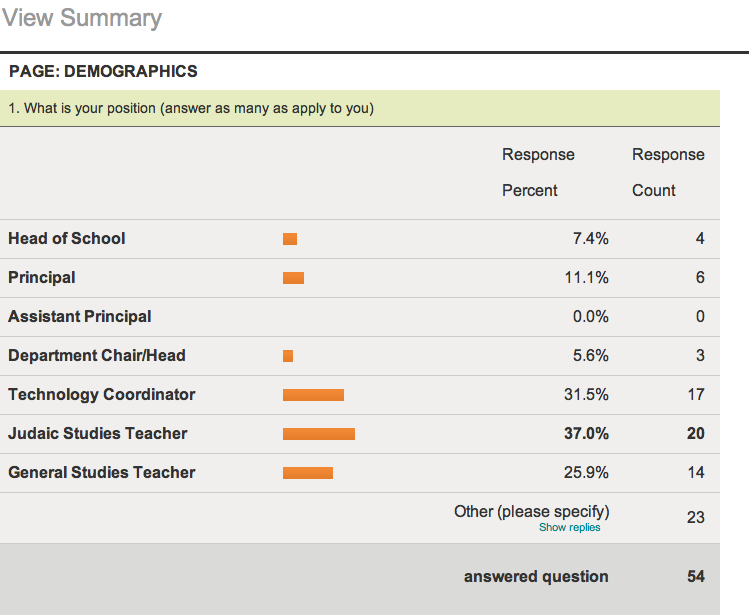
We are teachers, technology coordinators, administrators, and more. 37% of us are Judaic studies teachers, 25.9% of us are general studies teachers, and 5.6% of us are department chairs. 31.5% of us are technology coordinators and there are a number of technology directors as well. 11.1% of us are principals and 7.4% of us are heads of school. Also included among our members are a school board president, the Director of Educational Leadership at a Board of Jewish Education, a curriculum writer, student programming directors and coordinators, a parent, a religious school director, and a learning strategist.

We work with pre-k through twelfth grade students, with the following distribution:

Pre-School 19.1%

K-2 35.3%

3-5 39.7%

6-8 55.9%

9-12 42.6%

Why do we participate in YU2.0?

We are motivated to participate in YU2.0 for a range of reasons, shared below in order of expressed importance:

1. Using educational technology and social media to more effectively support student learning High: 49.1 % Very High 41.8%

2. Keeping updated on trends and advances in educational technology High 41.5%  Very High 45.3%

3. Using educational technology and social media more effectively in our own professional learning High 38.2% Very High 38.2%

4. Extending and strengthening the network of educators with whom to learn High 49.1% Very High 21.8%

5.Interacting with others specifically interested in educational technology integration and social media in Jewish schools High 30.8% Very High 34.6%

6. Making a contribution helping and mentoring others High 47.2% Very High 13.2%

7. The opportunity to work collaboratively on projects with others High 21.8% Very High 20.4%

One member wrote in an interest in increasing and strengthening connections between Israel and those outside of Israel. Another wrote, “educational technology is one tool. I am a big techie but find that people who are very into the tech side of education forget that it is about the kids because they are so into the technology.”

What do we hope to learn with YU2.0?

We are seeking to develop a range of skills, shared below in order of expressed importance:

1. Educational technology resources for student learning High 44.4% Very High 48.1%

2. Keeping up to date on emerging trends in educational technology High 45.5% Very High 41.8%

3. Educational technology resources for our own professional development and growth High 41.8% Very High 38.2%

4 Web 2.0 resources for our own professional development and growth High 40.7%  Very High 37.0%

5.Web 2.0 resources for student learning High 40.0% Very high 32.7%

6.Developing school wide learning plans for technology integration high 35.2% Very high 38.9%

7.Using the Smartboard interactively High 34% Very High 39.6%

8.Google apps in the classroom High 38.9% Very high 24.1%

9.The Judaic Studies classroom, integrating technology and social media High 29.6% Very high 31.5%

10. Technology coaching and technology peer coaching to support other educators implementing technology High 22.2% Very High 37.0%

11.Creating videos with students High 34.5% Very High 21.8%

12. Ipad use in the classroom High 31.5%  Very High 24.1%

13. Planning for school wide iPad implementation High 18.9% Very High%

14.Connecting students with other students using social media and educational technology High 25.9% Very High 11.1&

15.Blogging and portfolios with students High 20.8% Very High 15.1%

16.Podcasting with students High 16.7%  Very High 9.3%

One member wrote of interest in flipped learning both for classrooms and faculty meetings. Another wrote in interest in fundraising for moving to a technology based education and communication system. Several wrote in about interest in blended and on-line learning, including school-industry partnerships.

What are obstacles we face in terms of more effectively utilizing educational technology and social media?

1. Too many other demands on my time 57.4%

2. Competing school priorities requiring my focus in other areas 50%

3. Insufficient technology tools available 42.6%

4. Insufficient professional learning 38.9%

5. Competing professional priorities of mine requiring my focus in other areas 38.9%

6. Insufficient knowledge of available resources 29.6%

7. Being overwhelmed with the multitude of options available 27.8%

8. School policies blocking access to sites and resources I might use 20.4%

A number of members wrote in that financial constraints are a significant obstacle. One wrote in that lack of interest among teachers who have little time is an obstacle. One wrote in that educational technology duplicates preexisting materials without proven benefits.

What are the benefits of YU2.O to our members?

Benefits, in order of importance, include:

1. I am learning new things from my colleagues on YU2.0 that are helpful to me Agree 63%  Strongly Agree 6.5%

2. There is a feeling of community and shared identity as Jewish educators Agree 46.7% Strongly Agree 20%

3. The conversations on Yu2.0 are interesting and important to me Agree 59.6% Strongly Agree 4.3%

4. We are creating new knowledge together Agree 51.1%  Strongly Agree 8.9%

5. I am not comfortable sharing my questions on YU2.0 Disagree 48.9% Strongly Disagree 13.3% (on this question disagreement indicates comfort in the community)

6. I do not feel that members on YU2.0 have a common purpose Disagree 37.8% Strongly Disagree 24.4% (on this question disagreement indicates members do have a common purpose)

7. I am sharing what I learn from YU2.0 with colleagues at work  Agree 48.9% Strongly Agree 8.5%

8. There is a growing sense of trust, ease, and valuing of relationships with peers on YU2.0 Agree 44.4% Strongly Agree 13.3%

9. I am confident if I ask a question I will receive helpful, respectful feedback Agree 48.9% Strongly Agree 8.9%

10. I am able to contribute something of value to the group Agree 44.4% 4.4%

11. Participating in YU2.0 has not changed the way I use technology at work Disagree 38.3% Strongly Disagree 6.4%(on this question disagreement indicates that participation has changed the way members use technology at work)

How might we expand our Community of Practice?

We expressed interest, in order of priority, in:

1. Face to face conferences or Edcamps High 40.7% Very High 27.8%

2. Presentations from guest experts High 56%  Very High16%

3. Streamed conferences or decamps High 48.1% 16.7%

4. Webinars High 44.2% Very High 19.2%

5. Opportunities to coordinate visiting each other’s schools High 39.2%  Very High 27.5%

6. Peer presentations and collaborative problem solving High 41.5%  Very High 18.9%

7. Connections for collaborative projects among YU2.0 members High 38.5%Very High 19.2%

8. Connections for peer mentoring among YU2.0 members High 34%  Very High 15.1%

9. Google + Hangouts High 23.1% Very High 19.2%

10. Real time conversations using social media High 30% Very High 14%

11. Twitter hashtag High 23.1% Very High 9.6%

How might we use our periodic e-mail updates?

40.8% of members find the periodic e-mail updates valuable and  4.1% find them very valuable. 38.8% find them somewhat valuable and 16.3% find them not so valuable. Items members would like included in periodic e-mail updates in the future include: top post, best links to new information, technology that improves a specific aspect of education rather than how to integrate technology into education (focus on education with technology as a tool, rather than technology as the goal with education being the platform), information on teaching Judaic Studies with technology, event updates, innovations, ideas, resources, how other professionals and teachers are using various tools in the classroom, connections to current events, what schools are doing, and new groups that have formed within YU2.0.

What are leadership roles of interest to members?

Members wrote in that the would be interested in:

  • Being a regular guest blogger
  • Sharing knowledge about teaching Hebrew with technology
  • Connecting on twitter and Facebook
  • Teaching a webinar
  • Facilitating a subgroup
  • Organizing an online conference
  • Organizing face to face or online meetings to strengthen relationships
  • Teaching about iPad integration in schools
  • Speaking about creating student movies
  • Supporting schools to implement hybrid learning approaches in which technology is a tool to improve the quality of learning
  • Just about anything if it will further my knowledge and abilities in educational technology

What questions does this data raise for you? What recommendations, based on the data, do you have for our Community of Practice? How might we reflect, analyze, dream, and plan?


Gooooooal!

cc licensed image shared by flickr user Sean MacEntee

cc licensed image shared by flickr user &DC

Gooooooal! declares the sports announcer. Gooooooal! exclaims my jubilant husband. The excitement of my Argentinean spouse as his soccer (or rather football) team scores a goal is contagious.

Gooooool! I cry. Or, at least I do in my mind. The goals I celebrate are different than football goals. They are aspirations.

I am a principal, serving students with a broad range of interests, curiosities, and capabilities; helping them discover themselves as they are in the present and supporting them to embrace the potential in themselves as they are becoming. I am a supervisor, assisting teachers to recognize and build on their current skills, while guiding them to envision themselves as the increasingly skilled activators of student learning they are becoming. I live in a world of imagining the possible.

It’s professional goal setting time at school and I’m so proud I feel almost ready to sing out in celebration: gooooooal!

I meet, one on one, with each teacher. I meet as a group with our professional leadership team (myself, assistant principal, psychologist, and admissions director), during which time each of us set a professional goal; a particular area that will support student learning in which to delve deep. These are not necessarily our school-wide goals and strategic plan, although often times they reflect school-wide momentum and effort. These are individual goals; reflecting our unique professional journeys. By no means the whole of our work; our goals nonetheless ground our aspirations, reminding us that professional learning, like learning more broadly, is a process, benefitting from focus, time and dedication.

Some goals our teachers have chosen for themselves include:

  • To develop a broader, more nuanced approach to assessing student learning and to utilize gleanings from those assessments to plan ongoing instruction
  • To create a learning environment in which all students participate actively in both full class and small collaborative group activities
  • To gain greater skill in designing differentiated learning experiences for collaborative and independent student learning 
  • To strengthen relationships with parents utilizing technology and face to face connection 
  • To develop greater comfort and skill in teaching math, including differentiation for strong students
  • To in a serious way collaborate with members of the grade level team in order to support student learning

My own goal is to improve the quality and effectiveness of our supervisory, evaluative, and support processes for teachers.

We’ve only just begun, and many of our teachers are still setting goals. Each goal includes an action plan, supports for meeting the goal, and means by which we will assess success. We will monitor progress throughout the year and evaluate ourselves based on growth.

cc licensed image shared by flickr user carnavalboquense

While proud of our teachers, I worry. Will we be pulled back by the many obstacles constantly present – limited time, limited resources, the priorities of others? Will we be distracted by the crises that inevitably occur? Will we be drained by the pressures to move perhaps too quickly toward our goals, neglecting to reflect, change course as needed, and adapt when necessary?

cc licensed image shared by flickr user Niklas Hellerstedt

 Or will we ponder, embrace support, and consider our course carefully? Will we pace ourselves thoughtfully in order to make meaningful progress over the long haul?  Will we consider multiple approaches toward meeting our goals? Will we remain open to alternative perspectives and approaches? Will we seek to learn from our strengths and successes as well as from our missteps and mistakes?

What advice do you have for us? We welcome your wisdom.

Principal's Office

cc licensed photo shared by flickr user ecastro

“Do you know, there are kids who are afraid of principals?” I asked with a smile, turning to the first grade teacher who sat with me and a nervous six year old. We had just finished reassuring this child that we had spoken to him about his behavior on the bus the day before, not because we were angry, but because we were  concerned about his safety. We knew from his mother that he was indeed afraid of principals, so afraid that he convinced his younger sister that she should be terrified of her gentle and caring nursery school director.

The child began to giggle and I turned to him, smiling. “You’re laughing. You must have heard of kids who are afraid of principals.” 

“I’m one of those kids. I’m afraid of principals.” he said emphatically, his eyes widening and his giggles  transforming into a deep belly laugh. The teacher and I burst into genuine laughter right along with him. The teacher then stated what had already become obvious to him; he need not be afraid. He left my office chatting happily with his teacher, having gained newfound trust in me and, I’d venture to say, principals generally.

I imagine he is not alone. I imagine there are not only students, but also teachers in many if not most schools who, if answering honestly might declare, “I’m one of those teachers. I’m afraid of principals.”

As I prepare for upcoming individual conferences with each teacher to discuss professional learning goals, supports, action plans to meet goals, and ways of monitoring, assessing, and celebrating progress, I wonder. As I visit classrooms, offering feedback, compliments, and engaging with learning and teaching, I wonder. As I seek ways of meaningfully showing appreciation, admiration, and respect for teachers, I wonder. How might we hold high expectations, without blame and criticism, but rather with support and mutual accountability for student learning and well-being? How might we transform judgmental evaluation processes, with the potential to be fear-provoking, irrelevant, or both, into a commitment to meaningful professional learning, sharing, and growth?

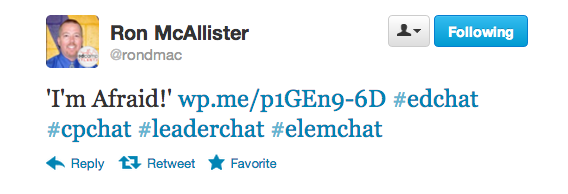
It’s not only students and teachers who are afraid. Sometimes, principals are afraid as well. Our fear struck me upon reading a recent tweet, with a link to a blog post: I’m Afraid!

Ron McAllister is a colleague to whom I frequently turn for insight and his words resonate powerfully with me as he poetically states:

I am afraid that I will not inspire my staff.
I am afraid that I will not appreciate them enough.
I am afraid that I will not provide enough support to them.
I am afraid that I will not give specific enough feedback directly linked to improved teaching and learning.
I am afraid that I will not be learning quickly enough to stay current with best practice.

I read Ron’s words with respect for his honesty and with admiration for his aspiration. And, I wonder. What if we reframed our  fears as aspirations?

I aspire to support teachers to find inspiration within themselves. 

I aspire to show appreciation and gratitude to teachers by recognizing contribution and complimenting effort and accomplishment.

I aspire to put a wide variety of supports into place and to trust teachers to choose the supports of greatest value to them. 

I aspire to provide feedback in the form of nonjudgmental observations and questions, specifically linked to teachers’ professional learning goals and evidence of student learning.

I aspire to take in feedback with humility, to remain open to ideas and possibilities, and to continue learning and aspiring. 

How might we transform our fear into creative, energetic aspiration? I welcome your insights.